1970’s Boys Comics

Boys comics of the 1950s and 60s presented a world of constant, dependable friends and reliable traditions. Easter always brought loads of adventures involving eggs. In August, the sun always shone on the sands, the cliffs, the lighthouses, the sparkling sea and the crabs. In November, the pages and the title whirled with sparks and whooshing rockets. And at Christmas – apart from slap-up feasts of spherical puds and cigars – there would always be snow on the lettering and a cascade of presents and overflowing stockings, often distributed from the open cockpit of a plane by a genial Santa Claus. Reading them required, of course, a complete acceptance of people rolling downhill engulfed in a monster snowball; of dogs, snakes, horses, bears and ostriches being able to talk; and of lightbulbs hovering over people’s heads containing the word “Idea”.

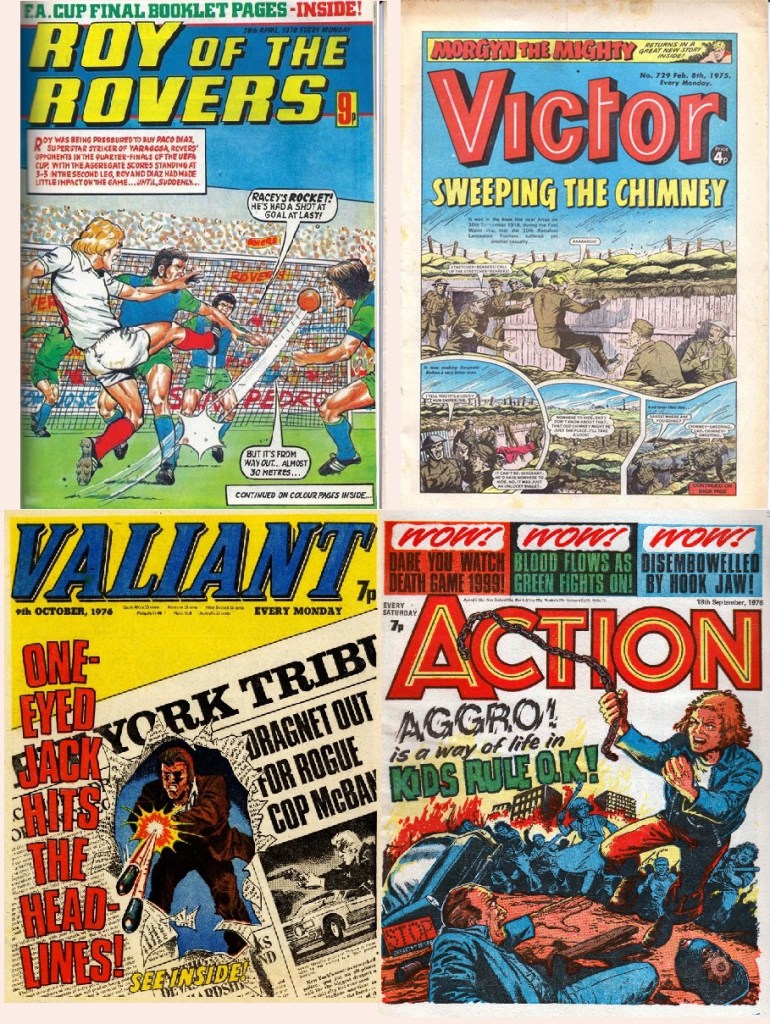
Many boys’ comics of the 1970s focused on adventure, humour, and action, often featuring relatable characters and exciting storylines. This era saw a continuation of themes from previous decades, with a strong emphasis on friendship, bravery, and fun. A variety of boys’ adventure comics, with titles like Valiant and Tiger gained popularity, featuring new adventure heroes as they continued to adapt to the changing tastes of the audience.
The rise of television and the introduction of colour television in the UK also influenced the comics industry, leading to a shift in focus towards television-related characters. comics began to adapt by incorporating more dynamic and engaging narratives, often reflecting contemporary issues and interests of young readers. The mid 1970s saw a mix of traditional and new styles, as well as a growing interest in science fiction and superhero comics in such titles as Action and 2000AD.
These are some I remember perusing in my folks’ newsagent shop.

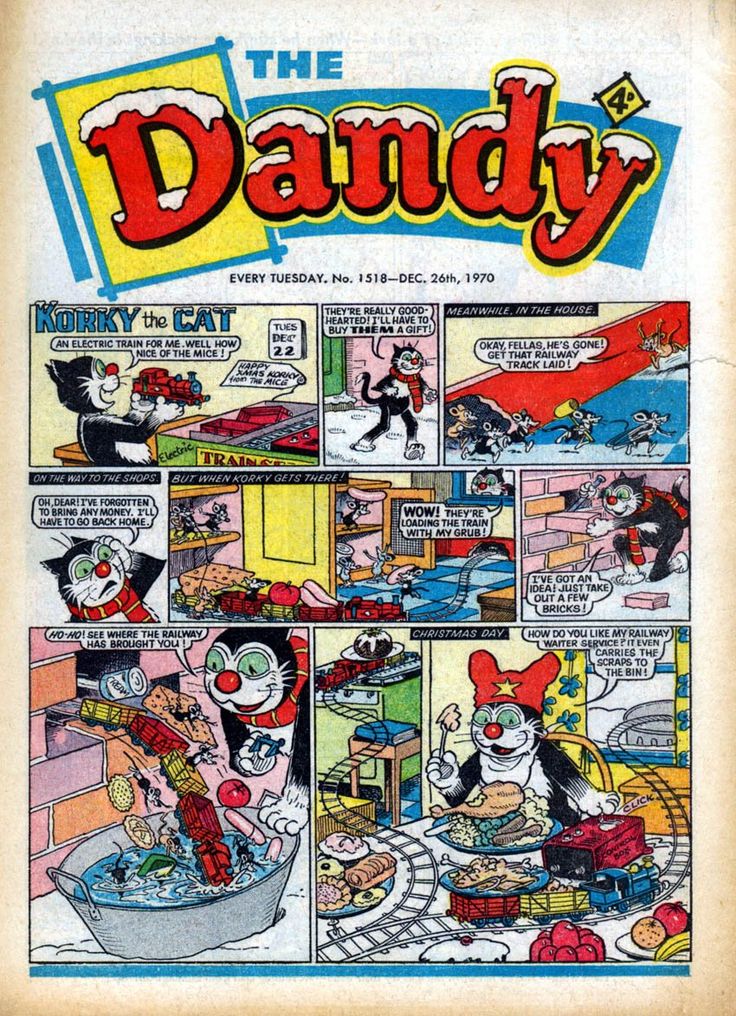
The Dandy
A British children’s comic magazine published by the Dundee based publisher DC Thomson whose first issue was printed in December 1937. The most notable difference between this and other comics of the day was the use of speech balloons instead of captions under the frame. The comic has had a number of different cover stars (comic strips appearing on the front cover), firstly Korky the Cat, who was on the cover from 1937 to 1984. Desperate Dan, long since the comic’s most popular character, then took over the cover until 1999. Some of the most popular characters include:
  •   Desperate Dan – A wild west character, the world’s strongest man who can lift a cow with one hand. His beard is so tough he shaves with a blowtorch.
  •   Korky the Cat – A black, male talking cat who behaves like a human and is accepted in a world of humans
  •   Hungry Horace – The adventures of a boy who thought of nothing but eating.
  •   Beryl the Peril – Originally in The Topper, she devilishly tormented her parents and other members of her community, causing chaos through menacing her neighbours, parents and school teachers – a female Dennis the Menace (created by the same artist).

The Beano
Anxious to repeat the success of their comic, The Dandy, Scottish publishing house DC Thomson introduced The Beano just 35 weeks later in July 1938. It was practically a replica of the first comic and, again, proved a great success. It is now the longest-running British children’s comic. During World War II, The Beano switched to fortnightly publication to save paper, alternating weekly with The Dandy. Illustrating the great British ability to laugh in the face of adversity, The Beano continued to serve up jokes and stories, laced with a large helping of patriotism as the comic’s characters tackled the Nazis in highly-imaginative ways. Documents found after the war revealed that, along with the editors of some national British newspapers, the editors of The Beano and The Dandy would have been arrested had Hitler’s forces invaded Britain. Some of the most popular characters include:
  •   The Bash Street Kids – Smiffy, Plug, Danny and the other ageless reprobates of Bash Street High School
  •   Dennis the Menace – The crown prince of British comicdom. Lumbered with his lifelong foe Walter the Softy, Dennis arrived on 17 March 1951 and later joined by his pet dog, Gnasher (an Abyssinian wire-haired tripe hound)
  •   Lord Snooty and his Pals – The adventures of Lord Marmaduke Bunkerton (aka Lord Snooty) who wore a Lord Fauntleroy suit without explanation
  •   Minnie The Minx – A feisty, energetic tomboy, preferring mischievous and violent antics over those that would be normal for a typical ten-year-old girl.
  •   Pansy Potter the Strong Man’s Daughter – The strong-arm girl who became a household name.

Buster
Launched in the 1960s, “Buster” continued to be a significant boys’ comic in the 1970s. It featured humour and adventure stories, appealing to a wide audience of young readers. The comic was known for its engaging characters and entertaining plots, making it a staple in many households. The title character, whose strip usually appeared on the front cover, was originally billed as Buster: Son of Andy Capp, and Buster wore a similar flat cap to reinforce the connection. The decade saw the incorporation of new characters and stories, such as the mad German scientist in “Von Hoffman’s Invasion” and the Sludgemouth Sloggers. Some popular characters include:
  •   Faceache: A young boy with the ability to change colour at will, known for his mischievous and humorous antics.
  •   Johnny Samson: A young mad inventor with a penchant for creating inventions that often lead to trouble.
  •   Crabbe’s Crusaders: A group of young adventurers who embark on various quests and adventures.
  •   The Toys of Doom: A collection of toys that come to life and embark on their own adventures.
  •   The Leopard of Lime Street: A story featuring Billy Farmer, a boy who discovers he has the strength of a leopard after being scratched by one.

Victor
The Victor was a British comic paper published weekly by D. C. Thomson & Co. Ltd. The Victor ran for 1,657 issues from 25 January 1961 until it ceased publication on 21 November 1992. Many of The Victor’s stories focused on the exploits of the British military in World War II and each week the front cover carried a story of how a medal had been won by British or Commonwealth forces during the Great War or the Second World War. In addition to these, the comic also featured science fiction stories, adventure stories and sports stories. The emphasis was on the ordinary man or boy involved in action adventures. Stories involved decent, upstanding British or Commonwealth men and boys fighting in wars, or competing on the sporting field or in general adventures, including sci-fiction yarns. Well known characters such as Alf Tupper, the runner; Sergeant Matt Braddock, World War Two pilot; Morgyn the Mighty, the strong man and Gorgeous Gus, the rich owner/sometime football player, who had all appeared in other D.C. Thomson comics, were dusted off and given a new lease of life in The Victor. These four characters were the backbone of the comic and one or all of them appeared almost in every issue for the first twenty years.

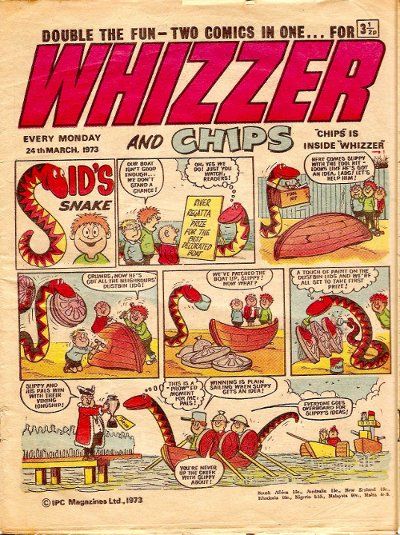
Whizzer and Chips
A British comics magazine that ran from 18 October 1969 to 27 October 1990, when it merged with the comic Buster. As with most comics of the time, Whizzer and Chips was dated one week ahead of the day it actually appeared on newsstands in Great Britain. The format of Whizzer and Chips presented the comic as being divided into two separate parts—a novel idea at the time. One part was called Whizzer and the other was called Chips, with Chips existing as a separate pull-out section in the middle. The slogan “Two comics in one, double the fun!” was used. One ongoing concept was that the two comics were fierce rivals. A guest appearance by a character from one of the comic strips in the story of one in the other magazine would be described as a “raid”, and the other comic would seek its revenge with a raid of its own the following week.
Readers were encouraged to become either a “Whizz-Kid” or a “Chip-ite”, depending on which section they preferred. The leader of the Whizz-Kids was a boy called Sid and his snake Slippy, from the Sid’s Snake comic strip. The leader of the Chip-ites was a boy called Shiner from the comic strip of the same name, who had aspirations to become a boxer and always ended up with a black eye (the eponymous “shiner”).

Action
Launched in 1976, “Action” was known for its controversial and gritty content, which included stories about war, crime, and adventure. It pushed the boundaries of what was acceptable in children’s comics at the time, leading to both popularity and criticism. While initially a sales success, the comic quickly received media criticism for its violent content, causing a moral panic that ultimately saw it withdrawn from sale by IPC in October 1976, amid rumours it was to be banned. Action returned two months later in a much-sanitised form, quickly losing readers and being cancelled the following year. The comic was eventually merged with “Battle” but left a lasting impact on the genre.

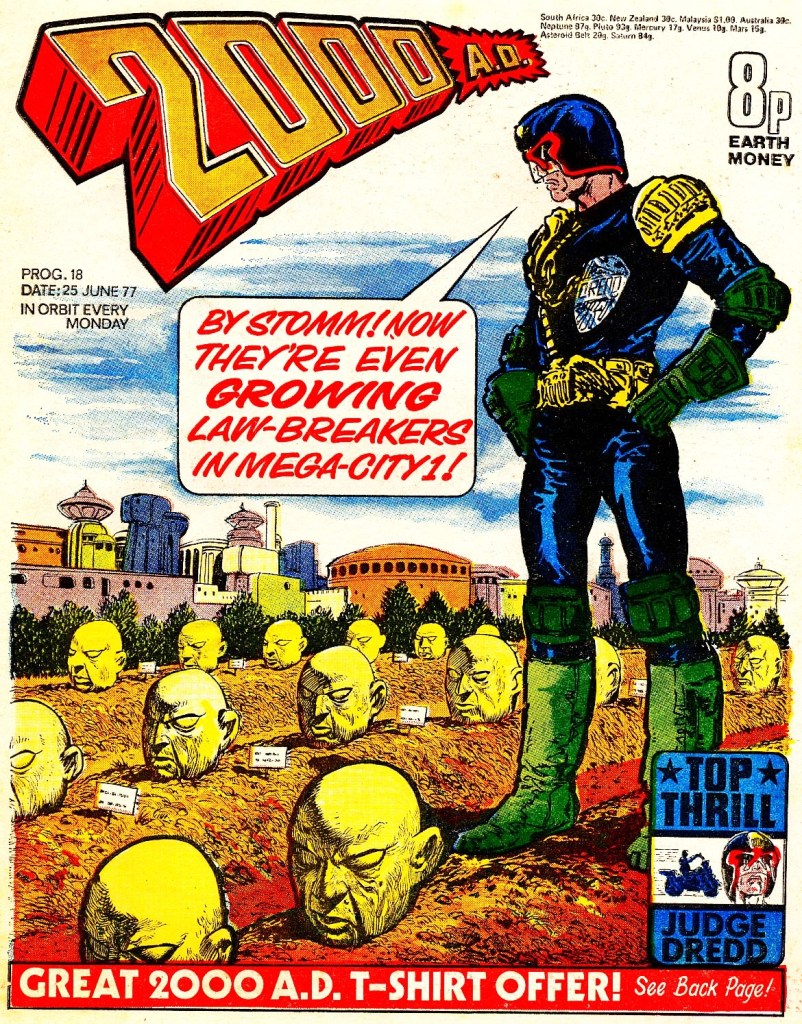
2000AD
This comic debuted in 1977 and quickly became a landmark publication in British comics. It introduced readers to a darker, more mature style of storytelling, with iconic characters like Judge Dredd, a law enforcement and judicial officer in the dystopian future city of Mega-City One, which covers most of the east coast of North America. He is a “street judge”, empowered to summarily arrest, convict, sentence, and execute criminals. Judge Dredd stories often satirise American and British culture, with a focus on authoritarianism and police brutality. The comic’s blend of science fiction and social commentary resonated with older boys and teenagers, setting a new standard for comic storytelling. Other series in 2000 AD include Rogue Trooper, Sláine, The Ballad of Halo Jones, Strontium Dog, ABC Warriors, Nemesis the Warlock and Nikolai Dante.

1970s Women’s Magazines

The 1970s was a decade marked by significant social change, including the feminist movement, which influenced a significant evolution in women’s magazines, reflecting cultural shifts, feminist movements, and changing societal norms. The revolution in fashion magazines saw some begin to reflect the eclectic styles of the era, for example Vogue and Harper’s Bazaar. These publications not only showcased fashion trends but also served as cultural barometers, introducing readers to new designers and political commentary intertwined with fashion.
Key publications began to address women’s rights, sexuality, and personal empowerment more openly, reflecting the evolving roles of women in society. Magazines became platforms for discussing issues that were previously considered taboo, contributing to a broader cultural dialogue about gender equality and women’s liberation. They played a crucial role in shaping public perceptions of women’s issues, offering a mix of lifestyle content, feminist discourse, and cultural commentary that resonated with readers during a time of significant change.

Cosmopolitan (stylized in all caps) is an American quarterly women’s fashion magazine for entertainment first published based in New York City in March 1886 as a family magazine. Known for its frank approach to sex and relationships, Cosmopolitan became a leading women’s magazine during the 1970s. It offered practical advice on careers and relationships, blending accessible feminism with lifestyle content. The magazine’s bold editorials and features helped shape the discourse around women’s rights and empowerment during this transformative decade. Helen Gurley Brown became chief editor in 1965 and radically changed the magazine. Brown remodelled and re-invented it as a magazine for modern single career women, completely transforming the magazine into a racy, contentious, and successful magazine. As the editor for 32 years, Brown spent this time using the magazine as an outlet to erase stigma around unmarried women not only having sex, but also enjoying it. Known as a “devout feminist”, Brown was often attacked by critics due to her progressive views on women and sex. The magazine eventually adopted a cover format consisting of a usually young female model (or prominent female celebrity), typically in a low cut dress, bikini, or some other revealing outfit.

British Vogue (stylised in all caps) is the British edition of the American fashion magazine Vogue. The magazine was launched in 1916 by Condé Nast, linking together fashion and high society. British Vogue is the third most profitable edition of Vogue worldwide (other than the American and Chinese editions). The magazine is published monthly twelve times per year. Within the United Kingdom copies of the magazine come without the ‘British’ in the ‘O’ in the publications logo.

Nova: This British magazine ran from 1965 to 1975 and was notable for its focus on current affairs, fashion, and taboo subjects like homosexuality and abortion. Nova challenged traditional women’s magazine norms by avoiding recipes and knitting patterns, instead showcasing high-quality photography and serious journalism. It became a platform for discussing women’s issues in a more progressive context.

Elle (stylized in all caps) is a worldwide magazine of French origin that offers a mix of fashion and beauty content, and society and lifestyle. The title Elle means She in French. Hélène, Elle’s pioneering founder, returned to Paris from New York City to create a unique publication that grappled with the many forces shaping women’s lives in France in 1945 Women won the right to vote in 1944, and Elle dove immediately into long-form “newspaper-like” features on women’s role in national politics and the growing feminist movement. Elle would “celebrate a new type of woman: independent, modern, active, comfortable in her own skin and her time”. On 2 April 1956, Grace Kelly appeared on the cover of Elle France, a few days before her marriage to Rainier III, Prince of Monaco. On 16 July 1956, Elle France featured Marilyn Monroe on the cover. By the 1960s, Elle had a readership of 800,000 across France and was said to “not so much reflect fashion as decree it.” This dominance was reflected in the famous slogan: “Si elle lit elle lit Elle (If she reads, she reads Elle)” Beverly Johnson became the first Black woman on the cover of Elle when she appeared in the 1970s. Lagardère Group subsidiary, Hachette Filipacchi Médias began pushing Elle outside of France in 1985, launching Elle in the UK and the United States.

For the more mature woman

People’s Friend: a British weekly magazine founded by John Leng on 13 January 1869 as an offshoot of The People’s Journal. The magazine is principally aimed at older women.[6] Each issue contains at least seven self-contained short stories and two serials (frequently more), a craft project (usually knitting or sewing) and various factual articles, one of which is a piece on a particular town. Pets, family and traditions are also common themes. During World War 1, the focus of the magazine shifted to women. The magazine’s geographical location in Dundee is reflected in a general bias toward Scottish subjects. The main front cover image is invariably a painting of a picturesque location somewhere in Britain or Ireland, and readers can also buy prints of these pictures.

My Weekly: a magazine for women published by D. C. Thomson & Co. Ltd of Dundee, Scotland. It tends to consist of short stories, reader contributions, knitting or sewing patterns, and celebrity gossip. There are no real life horror stories. My Weekly is a warm and welcoming women’s magazine. We’re proud to be your feel-good read. Every issue provides an inspiring mix of celebrity interviews, specially-commissioned cookery features, down-to-earth advice from expert columnists, and exclusive contemporary fiction. The publication originated as a newspaper. It was purchased by the Thomson brothers early in the twentieth century, and was relaunched as a magazine in 1910.

Woman’s Weekly magazine was launched in 1911, focusing on the home, family and lives of grown-up women, providing them with health advice and hints on how to feel good.

Woman & Home: founded in the UK in 1926, this magazine is published 12 times per year, in print and digital formats. Its mission is to allow women to celebrate, inspire and support each other, offering thought-provoking, informative and joyful reads. we celebrate and empower women in their 40s and older from all walks of life, with a rich collection of articles on fashion, beauty, celebrities, real life stories, inspirational women, homes, gardens, recipes, books, travel and more.

Woman’s Own: British lifestyle magazine aimed at women was first published in 1932, and in its early years it placed women’s rights and social problems firmly in the foreground. It includes articles on celebrity gossip, real-life stories, fashion, beauty, shopping deals, wellbeing, food, and travel.

Woman: an English weekly magazine launched in 1937. Its target audience is 30-to 40-year-old women. It encompasses a mix of celebrity gossip and TV news, real-life stories, and fashion and beauty tips. Its lifestyle section offers ideas on homes, interiors and food, product reviews, and advice.

Calamity Chicks 4.3

Helen Jackson
Helen rarely questioned her lot in life – it was what it was. From what she could tell, her mum had to put up with a darn sight more, so she felt it her duty to support her every way she could.
“I try not to treat you like a little girl, but sometimes I forget how quickly you’re growing up.” A sigh. “But you’ve always had an old head on your shoulders. Just now you sounded more like a sister than a daughter.”
Helen buried her head in Mum’s shoulder, squeezing tightly. She desperately wanted to confide about all the things her dad did which made her uncomfortable, but she was too afraid of the consequences. And it wasn’t just him.

Nikos
Dark, enigmatic and initially hostile, she soon discovered hidden depths. In halting English, he explained how the girl’s faithless boyfriend had left her for another woman, but snapped his fingers and she went running back.
She nodded. “A total rat. “I bet he’s still seeing other women.”
He nodded vigorously. “I think this, too. But Eleni has no senses about him. She is stupid.”
“Women in love rarely have any sense. Or dignity.”
“Yes. You speak right. She has no dignity about him. Like most girls. Ruled by their …” He used a Greek word which sounded like moon, but his hand gesture made the meaning clear and the curled lip showed his distaste.
She glanced out of the window, trying to hide her involuntary shiver – he was every bit as arrogant as her father.

Janet Jackson
Even though Helen repeated the words exactly as her sister had, Dad obviously didn’t believe her. Then Janet peeked round the door, taking great pleasure in dobbing her in. “She’s got her fingers crossed behind her back.” Her smug smirk turned into a squeal as he morphed into the daddy monster and chased her out, saying she had five minutes to hide before he came to gobble her all up.
Over breakfast, Janet point blank refused to help. “I’m not a slave, I’m only nine. Far too young.”
“Janet. I didn’t bring you up to be so rude. You apologise right now.” Mum looked mortified.
“It’s alright.” Aggie’s face wobbled. “The last thing I want is to make anyone feel like this is the Victorian age when they sent children up chimneys.”

Stella Brent
Helen watched her mum’s face desperately trying not to crumple into despair. But the anger which fuelled Mum’s every waking moment rose to the surface and she gripped Helen’s arm, the jagged edges of her bitten-to-the-quick nails digging into the soft flesh, seeking blood
Mum didn’t understand why Janet called her a fat, ugly old cow, so Helen tried to explain.
“Janet’s too young to know any better. When she moaned that you never let us have any fun, he said you’re jealous of us because we’re young, slim and pretty – everything you’re not.” She gulped as mum’s face went all wobbly. “It’s not true. You’re dead slim and gorgeous– ”

Jax (Sean Jackson)
Helen stared at the scruffy man whose beard and unkempt hair gave the appearance of a tramp.
He caught on, smoothing a dark lock which refused to be flattened. “Here’s me talking, I probably look in a far worse state. I came straight from the airport, but I probably should have had a haircut and shave first.”
“The Wild Man of Borneo motif suits you.” With a wink, Aggie returned to tea-making activities.
Jax was unlike any man she’d ever met – somehow she knew instantly he was worthy of her trust. For starters, he didn’t ogle her with the dark, greedy smiles of Dad’s creepy mates, nor cower behind anxious expressions like the timid characters she saw on TV. He seemed serious and sincere, suggesting strength like Sean Connery’s James Bond.

Auntie A (Aggie)
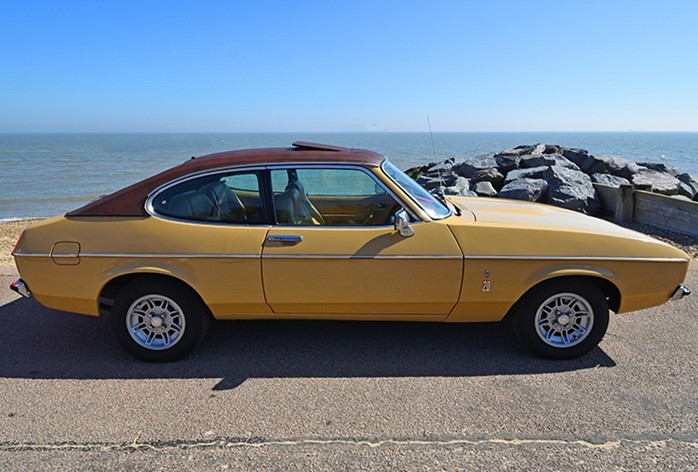
Aggie – nobody called her Agatha, despite her stern face – had recently bought a three-storey house overlooking the sea. The view out of their bedroom showed a long structure Aggie called a pier: one of two in Brighton.
“It’s a tourist attraction with a theatre at the end where famous comedians go to perform. I’ve booked us in for a show so you’ll see for yourself.”
After the weekend exploring the busy seaside town, Aggie explained her plans for restoring the house to its former glory and opening it as a guesthouse. “There’s an awful lot of work to clear all the bedrooms, and strip off the old wallpaper, and I’d appreciate any help. Otherwise, I’d have to pay a lot of money to a decorating firm.”

Penny
Helen met more of Jax’s family, discovering she had several cousins, including Clive’s daughter Penny, a year younger than Janet. On Penny’s first day, Janet brought her to the library after eating lunch, and Helen was surprised how much the younger girl’s studious attitude influenced her sister.

Chloe
Vaguely aware of a third girl joining Janet and Penny, she was struck by the girl’s ethereal fragility – far too insubstantial and naïve to survive in the tough school. The word fairy sprang to mind, and she couldn’t help but smile when she spotted her with a skinny lad who gave off a distinctly effeminate air. Truly a well-matched pair.

Charlie Evans
“Hey, Charlie. I thought I told ya to sort that so’s we can get some peace.”
A short, thickset girl with an almost military crewcut snorted. “I did. You know I did. He must’ve fixed it.” As the alarm clanged, she swore. “Shit. He’s rigged it with an alarm. The place will be swarming with staff any second.” As the others fled, she jumped down, staring at Helen’s head. “Bloody hell, girl. What happened to you?”
“A psycho with a pair of scissors.” Helen caught sight of herself in the mirror, the scars showing prominently against the dark stubble.
Charlie bent down to pick up the wig, in a sorry state after being trampled by several pairs of uncaring feet. “Looks like the wig bought it.” She tried to straighten the knotted strands.
The door burst open and a tall man in a beige overall loomed over them. “Gotcha.”

Justin Palmer
She couldn’t decide if he were a glib, “love ’em and leave ’em” type with a well-notched bedpost, a thief, or the worst kind of troublemaker. Basically a reprobate who reeked of dodgy dealings.
“Are you buying? Otherwise clear off.” The barman’s demeanour spoke of weary irritation.
“A Coke please.” He glanced at her. “Would you like ice in that?”
She nodded, not wanting to add to the man’s woes by challenging Justin’s arrogant assumption.
“Make that two cokes, both with ice.”
His grin suggested he’d read her thoughts, but he honestly looked the type who would be drinking beer despite being underage. For once, she couldn’t quite get a reading on him, but she would have put money on there being something dodgy, albeit buried deeply.

Calamity Chicks 4.2

Who doesn’t love a Greek island? Here’s one of Helen’s first experiences on one – not what you might expect.

   “Looks like it’s only you and me for the windsurfing.” Jax winked at Helen.
   She groaned. It looked quite technical, something she suspected Janet would have been much better at. But the idea of spending the day with her dad, doing something he enjoyed, appealed to her.
   Surprisingly, she managed quite well, once she understood it was mostly a matter of balance, and going with the flow. He suggested most people failed because they were afraid to fall in the water. “Once you realise a dunking is inevitable, you stop fighting it.”
   She wasn’t kidding when she said Janet was much better suited to sporting activities, but for some reason this one worked for her. Despite his forebodings, she didn’t fall off once. The half hour was over far too soon, but he hired a pedalo and they pedalled their way over to the other part of the beach to explore the cliff.

   When they reached the top, he asked if everything was okay with boys.
   “How do you mean, okay?”
   A scowl. “I don’t want to pry, but I definitely got a bad vibe off that Jason character.”
   “Jason?” A beat. “You mean Justin. That was ages ago – we finished at Easter.”
   He nodded. “Good. I got the impression it was all over, but you never mentioned it and, as I’ve said many times, I don’t like to pry.” His expression, however, said prying was exactly what he wanted to do. Or at least getting a feel for how the relationship had gone.
   She took pity on him. “I know you’re desperate to ask but worried about what I might reveal.”
   His face scrunched up. “Really? I’m that obvious?”
   “You have no idea. I’m guessing all fathers go through this at some point with their daughters.”
   He deadpanned. “You have no idea.”
   She chuckled. “I haven’t actually gone out with that many boys, because I find the majority to be far too immature. Most of them are only interested in the one thing I’m not prepared to give.”
   His eyebrows rose. “Pleased to hear it.”
   A sigh. “And I guess my experience with men has been somewhat tainted.”
   “Of course. Stella, I mean your mother, has been reluctant to shed too much light on what happened. But there are a number of things I wish she’d known about.”

   Helen was caught completely unawares as he grabbed her from behind. “What the heck?”
   “What would you do if someone did this to you?”
   Trying to get past the shock gripping her brain, she focused on how he was holding her captive, looking for the weakest link. His obvious strength meant there was little point in struggling against the grip on her wrists. At the very least, it would result in bruising.
   “Come on. If you don’t do something he could have you half-naked by now.”
   Helen knew one of the best strategies for a woman was to aim for her assailant’s genitals, but that only worked if the guy was face to face. She had no chance of kneeing him in the testicles with her back to him. And a head-butt was out of the question, although she doubted that particular tactic was something she would ever dream of using. Particularly on her beloved dad.
   The only weapons available were her feet, and she tossed up between stamping on his foot and kicking his shin. However, she couldn’t imagine practising on her dad because of the whole hurting thing.
   “Don’t worry about hurting me. I promise, you won’t do that.”
   She went for the foot stamp, figuring it would be easier to manage and less likely to overbalance her. But somehow he knew, moving his foot away so she only stamped the ground.
   “Good attempt, and it would have worked on most attackers, as long as they weren’t army trained.”
   But she was banking on the fact he didn’t know she’d watched several films featuring self-defence techniques. She followed up the manoeuvre with an elbow-jab aimed at his midriff, figuring his attention would be diverted enough to give some slack on his grip of her wrist.
   Unfortunately, she hadn’t reckoned on him being well versed in anticipating any moves she might make. He dodged her elbow, catching her arms behind her back, and capturing both wrists with one hand.
   “Good try. What will you do now?”
   She tried flexing her wrists, but his tight grip gave no room for manoeuvre. The part of her brain which registered pain stuck up a tentative hand, muttering about the level of discomfort, but what she understood as the fight-or-flight instincts shouted it down, needing full power to focus on an escape strategy.
   “Come on, girl. Every second counts. What are your instincts telling you to do?”
   She wanted to snarl at him to shut up and let her think, but she understood he was deliberately raising the stakes so the appropriate parts of her natural defence mechanism would kick in. Without the benefit of the sort of training he obviously received during his military career, she instinctively knew the only way she could best him would be with speed and something unexpected.
   Figuring most women would merely struggle against the grip holding them captive, she quickly dismissed this as a waste of energy. The whole superior strength thing. A couple of moves sprang to mind, but she wouldn’t feel at all comfortable doing them to her dad.
   “Stop analysing, just act. Whatever comes to–”
   He didn’t get a chance to finish as she sprang back, simultaneously twisting half a turn and jerking her shoulder into whatever part of his body was closest. Using the shock of the unexpected move and the momentum of her body against him, she managed to free her wrists and shoved hard, sprinting down the path, panting for breath.

   Half-way down she stopped, surprised he hadn’t appeared. Her first thought was she’d injured him in some way, and this quickly gave way to an image of the scene. Surely he wouldn’t have overbalanced and fallen down the cliff? Unable to bear the thought he could be suffering, she ran back, but he was nowhere to be seen. Was this even the right place? She scouted around for some indication, finally spotting an unusual cluster of rocks which reminded her of a badly-formed big cat. More of a tiger than a lion.
   “Of course, if you were really being attacked, you would never return to see if you’d injured your assailant.”
   She jumped as he appeared from behind a tree. “I thought you’d fallen over the cliff or something.”
   “Sorry. Badly-timed call of nature.” A chuckle. “And I had to search for some water to wash my hands.”
   “Did I hurt you? I heard a thump, but I was doing what you said and obeying my instinct to run.”
   “Not at all. More importantly, did I hurt you? I was trying to be gentle, but the instructor was clear that if we took it easy on the girls, they’d never be able to defend themselves against a real attacker.”
   “My wrists may be sore later on, otherwise I’m okay. A little warning would have been nice.”
   “That would have defeated the object. I wanted to assess your reflexes, and I have to say, they’re way better than I could ever have hoped. Your first instinct should always be to run, and that’s what you did, the moment you could.”
   “Except I came back.” She grinned.
   “Because you don’t realise how tough your old man is. I meant it when I said you couldn’t do anything to hurt me.”
   “You think?” She described one of the tactics which had run through her mind, and he winced.
   “Ouch. I pity the guy who tries to take you on.”
   “Am I right? Would it hurt more if I dug my nails in or twisted really hard?”
   His face screwed up. “Depends what he’s wearing. You won’t be able to do much through thick denim.”
   “But if he takes them off, it only leaves thin cotton.”
   “And you can be pretty sure of his intention if he’s down to his underwear. But would you have the nerve to grab hold of a stranger’s privates?”
   “If it was that or be raped, there’s no question. Nails or twist?”
   “Both if you can.” A shudder. “I consider it my duty to arm both you girls with some rudimentary self-defence techniques. It’s just a shame I couldn’t have taught Stella before I left. Then maybe the three of you wouldn’t have suffered so much.”
   “No point crying over spilt milk. If you had, then maybe we wouldn’t have Janet.”

Calamity Chicks 4.1

The fourth book in the series is Helen’s Hazard – here’s a little more about it.

What doesn’t kill you makes you stronger.
Helen figures she must’ve done something really bad in a former life to end up with her family: a sneaky sister dobbing her in to their deranged dad who delights in administering his twisted punishment ritual. Her mousey mum is too busy dodging punches to notice, and probably couldn’t do anything if she did.

Her Cinderella lifestyle takes a dark turn when Dad’s slimy mate babysits. He and his creepy girlfriend have strange ideas about games suitable for pre-teens, and she’s forced to swear a blood oath not to tell Mum. Those capricious fates have a few tricks – like a fairy godmother who reveals her true dad. But is it too late to save her from the monster?

As for handsome princes – they’re decidedly thin on the ground in her small English hometown, and inevitably turn into frogs when she kisses them. She never expected her first true love to be a Greek island, but she loses her heart to their way of life. Returning to work the summer before starting college, the first Greek man she encounters reeks of pride and arrogance. And she’s had way more than her fill of that.

A moonlit kiss gives her hope — but what’s the secret her sister won’t share, and will it destroy everything?

A modern Cinderella story with a flavour of Shirly Valentine and Mamma Mia
This cheeky piece of 70s British nostalgia features a courageous Cinderella, girl-powered escapes from hairy situations, a couple of unlikely heroes and the nastiest of villains. Feel free to boo and hiss.

Calamity Chicks:
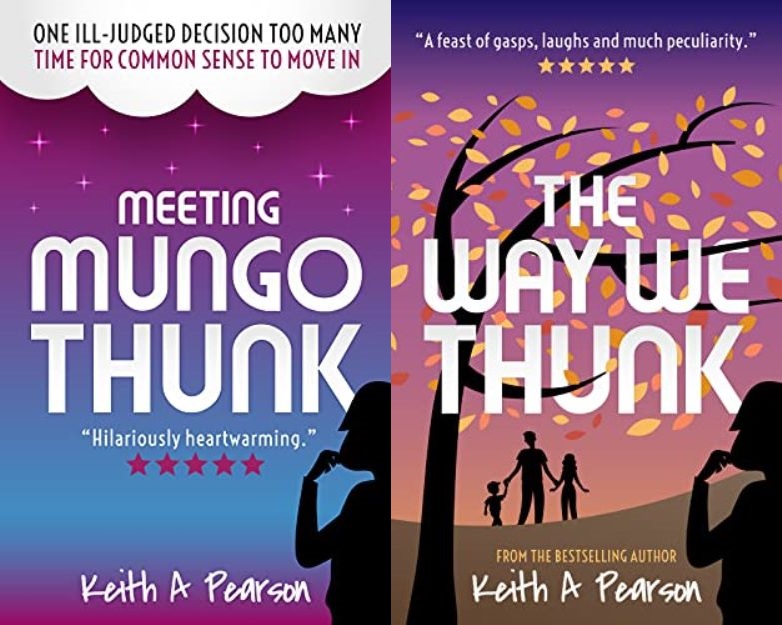
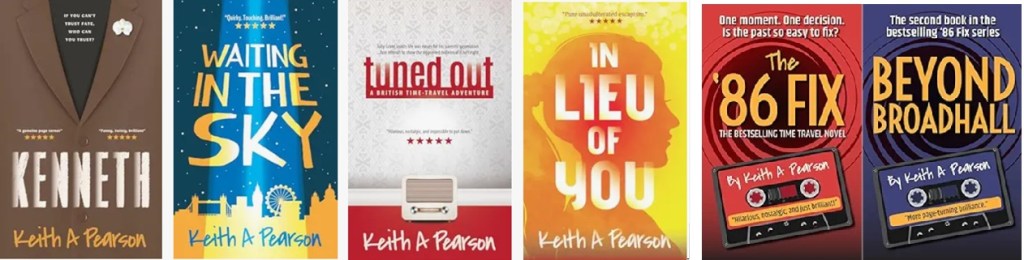
Endearing, coming-of-age romances with lashings of adventure and a hint of spicy danger. Set in 70’s Britain, they provide an immersive experience of growing up in a world without mobile phones and computers, but with the best soundtrack everrr!
#1 Tina’s Torment – Ugly Duckling
#2 Chloe’s Chaos – Goldilocks
#3 Linda’s Lament – Reluctant Rock Star
#4 Helen’s Hazard – Cinderella

Christmas Hits of the 80s and 90s

Part 2 of the Christmas lyric quiz – answers next week, and the ones for last week at the end of this post.

A) Let the Christmas spirit ring, later we’ll have some pumpkin pie.
B) You know that sweet Santa Claus is on the way.
C) Hallelujah, Noël, be it Heaven or Hell The Christmas we get, we deserve
D) Soon the bells will start and the thing that’ll make ’em ring is the carol that you sing.
E) So this is Xmas and what have you done.
F) Look to the future now, It’s only just begun.
G) He’s making a list, And checking it twice; Gonna find out Who’s naughty and nice.
H) Here we are as in olden days, Happy golden days of yore.

And here are the year-by-year Christmas hits from 80s, 90s and beyond
1980s
1980 – Jona Lewie – Stop The Cavalry
1981 – The Waitresses – Christmas Wrapping
1982 – David Essex – A Winter’s Tale, Shakin’ Stevens – Blue Christmas, Cliff Richard – Little Town, Frank Kelly – Christmas Countdown
1983 – Paul McCartney – Pipes Of Peace, Pretenders – 2000 Miles
1984 – Band Aid – Do They Know It’s Christmas?, Wham! – Last Christmas, Queen – Thank God it’s Christmas
1985 – Shakin’ Stevens – Merry Christmas Everyone, Bruce Springsteen – Santa Claus is Comin’ to Town, Aled Jones – Walking In The Air
1987 – Pogues featuring Kirsty MacColl – Fairytale Of New York
1988 – Cliff Richard – Mistletoe And Wine, Chris Rea – Driving Home for Christmas, Freiheit – Keeping the Dream Alive
1989 – Band Aid II – Do They Know It’s Christmas

1990s
1990 – Cliff Richard – Saviour’s Day, John Williams – Carol of the Bells, Whitney Houston – Do you Hear What I Hear?
1991 – Shakin’ Stevens – I’ll be Home for Christmas, Cliff Richard – We Should be Together
1992 – Darlene Love – All Alone on Christmas
1993 – Dina Carroll – The Perfect Year, Kate Bush – Home for Christmas
1994 – Mariah Carey – All I Want For Christmas Is You, East 17 – Stay Another Day, Bon Jovi – Please Come Home For Christmas
1995 – Luther Vandross – Every Year, Every Christmas, Michael Jackson – Earth Song
1996 – The Smurfs – Your Christmas Wish
1999 – Cliff Richard – The Millennium Prayer, Tom Jones & Cerys Matthews – Baby, It’s Cold Outside

2000s
2003 – The Darkness – Christmas Time (Don’t Let The Bells End), Billy Mack – Christmas Is All Around
2004 – Band Aid 20 – Do They Know It’s Christmas?, Celine Dion – O Holy Night
2007 – Kylie Minogue – Santa Baby, Michael Bublé – Have Yourselves a Merry Little Christmas
2008 – Status Quo – It’s Christmas Time, Alexandra Burke – Hallelujah
2009 – George Michael – December Song (I Dreamed of Christmas), Sir Terry Wogan & Aled Jones – Silver Bells
2011 – Michael Bublé – All I Want for Christmas is You, Christmas (Baby Please Come Home)
2012 – Michael Bublé – It’s Beginning to Look a Lot Like Christmas, White Christmas


Answers for last week:
1. Pogues featuring Kirsty MacColl – Fairytale Of New York 87
2. Wham! – Last Christmas 84
3. Chris Rea – Driving Home For Christmas 88
4. Mariah Carey – All I Want For Christmas Is You 94
5. East 17 – Stay Another Day 94
6. Shakin’ Stevens – Merry Christmas Everyone 85
7. Kate Bush – Home for Christmas 93
8. Band Aid – Do They Know It’s Christmas? 84
9. Kylie Minogue – Santa Baby 07 (Eartha Kitt 53)

Christmas Hits of the 60s and 70s

I used to run a lyric quiz on my last lesson before Christmas every year. Nothing to do with maths, but we’d do 3D initials on Isometric paper, or Christmas co-ordinates – basically a colouring in lesson with lots of Christmas music playing. See how you get on – answers next week.

1) You were handsome, you were pretty, Queen of New York City.
2) This year, to save me from tears I’ll give it to someone special.
3) I sing this song to pass the time away, driving in my car.
4) I just want you for my own. more than you could ever know
5) Baby if you’ve got to go away, don’t think I could take the pain.
6) Snow is falling all around me.
7) You know that I’ll be waiting to hear your footsteps saying.
8) At Christmastime we let in light and we banish shade.
9) Think of all the fun I’ve missed Think of all the fellas that I haven’t kissed.

It’s no good looking for clues below – all but one were released after 1979.

And now for the year-by-year Christmas hits.
This is not a comprehensive list by any means, but it includes many of my all-time favourites.

Early Hits
1942 – Bing Crosby – White Christmas
1951 – Perry Como – It’s Beginning to Look a Lot Like Christmas
1952 – Bing Crosby – Silent Night, Jimmy Boyd – I Saw Mommy Kissing Santa Claus
1953 – Eartha Kitt – Santa Baby
1957 – Harry Belafonte – Mary’s Boy Child, Frank Sinatra – Have Yourselves a Merry Little Christmas
1958 – Johnny Mathis – Winter Wonderland
1959 – Max Bygraves – Jingle Bell Rock, Dean Martin – Let It Snow, Let It Snow, Let It Snow

1960s
1960 – Ella Fitzgerald – Frosty The Snowman, Adam Faith – Lonely Pup (In A Christmas Shop)
1961 – Nat King Cole – The Christmas Song
1962 – Brenda Lee – Rockin’ Around The Christmas Tree
1963 – Johnny Mathis – Have Yourself A Merry Little Christmas, Andy Williams – It’s The Most Wonderful Time Of The Year,
The Beach Boys – Little Saint Nick, Bing Crosby– Do you Hear What I Hear?, The Crystals – Rudolph the Red-nosed Reindeer,
Dora Bryan – All I Want For Christmas Is A Beatle
1964 – Burl Ives – A Holly Jolly Christmas, Elvis Presley – Blue Christmas
1966 – Elvis Presley – If Everyday Was Like Christmas, Dean Martin – A Marshmellow World
1967 – Barbra Streisand – The Christmas Song, The Beatles – Christmastime Is Here Again
1969 – Engelbert Humperdinck – Winter World Of Love

1970s
1970 – José Feliciano – Feliz Navidad, The Carpenters – Merry Christmas Darling, Jackson 5 – Santa Claus is Coming to Town
1971 – John and Yoko and The Plastic Ono Band – Happy Xmas (War Is Over)
1972 – Mud – Lonely This Christmas
1973 – Slade – Merry Xmas Everybody, Wizzard – I Wish It Could Be Christmas Every Day,
Elton John – Step into Christmas, Steeleye Span – Gaudete
1974 – The Wombles – Wombling Merry Christmas, Showaddywaddy – Hey Mr Christmas, Mud – Lonely This Christmas
1975 – Greg Lake – I Believe In Father Christmas, Chris de Burgh – A Spaceman Came Travelling, Mike Oldfield – In Dulce Jubilo,
The Four Seasons – December, 1963 (Oh, What a Night), Dana – It’s Gonna be a Cold, Cold Christmas,
Love Unlimited – It May Be Winter Outside (But In My Heart It’s Spring
1976 – Johnny Mathis – When A Child Is Born, Jethro Tull – Ring out Solstice Bells
1977 – Donna Summer – Winter Melody
1978 – David Bowie and Bing Crosby – Peace On Earth/Little Drummer Boy, Boney M – Mary’s Boy Child
1979 – Paul McCartney – Wonderful Christmas Time, Kate Bush – December Will Be Magic Again

Your 1970s Memories

The Calamity Chicks books are set firmly in the seventies and are loosely based on things which happened to me – especially the dancing, sailing and skating. And even the bits set in recording studios or featuring bona fide Hell’s Angel bikers.
Yep, I had full-on teenage experiences which inevitably find their way into many of my series, one way or another.
I’m hoping several of the things which happen to my beleaguered heroines will resonate – particularly with readers of a certain age brought up in the UK 😉
To give you a clue, here are some examples. Remember these are coming-of-age stories, so they start off young:

Tina’s Torment
* Playing in a den in the park
* O-levels/A-levels
* Nasty bully
* School disco at lunchtime
* 6th form sports afternoon (sailing)
* Saturday afternoon shopping – Woolies!
* Cinema showing short film before main feature
* The stench of pot in the uni students union bars
* Dad moaning if a phone call lasted longer than ten minutes

Chloe’s Chaos
* Playing British Bulldogs
* Being on the dummy tables
* Nasty homophobic bully
* Peer pressure to “do it”
* Leaving school after O-levels/CSEs
* Near-escape with “bad-lad”
* Saturday afternoon skating
* Dreadful misogynistic rules of biker gangs
* Reuniting with first ever love

Linda’s Lament
* I’ll show you mine …
* 11 plus tests – weird brain wiring required to succeed
* Neurotic mother who gave up career when pregnant
* Nasty bullying nuns at convent school
* School musical productions
* Saturday job in recording studio
* Learning to drive – getting first car
* Working in pub – MC club baptism of fire
* Meeting “the one” at uni freshers disco

The next book, Helen’s Hazard is now available to pre-order – released on 2nd January 2026.

Helen’s Hazard
* Sibling favouritism – cuckoo in nest
* 11 plus test – the consequence of failure
* Gangs guarding gym entrance
* Seeking refuge in school library
* Unsavoury attentions of babysitter
* Discovering real father – life begins
* Falling in love with a different country – Greece
* Tackling a demanding psychology degree
* Taming an arrogant Greek restauranteur

I’d love to know if any of these resonate with you – let me know in a comment.
And the first 5 people who add an experience of their 70s – in particular your top 3 songs from that decade – will get a code to download a free copy Tina’s Torment.

Calamity Chicks 3.3

Linda
Linda’s childhood saw her stumbling from one disastrous scene to another, mainly due to bad choices of her parents. Her dad, Chris, a loveable rogue, was the leader of Granite’s road crew, but his boss, Uncle Teddy, had some unsavoury inclinations. But her mother Marcia’s neurotic hang-ups result in even more heartache.

Jack Thomas
Undoubtedly the best-looking boy in her junior school, Jack was also the brightest. Despite this, he was the only person in her entire life who hadn’t made her feel fat, ugly or a nuisance. When they met again in high school, they partnered as leads in a couple of school shows, but the onstage chemistry between them fizzled out when she met his girlfriend.

Granite
Lin’s experience on tour with the band forced her to grow up faster than normal, but there were advantages – mostly in the shape of Mindy, the band’s seamstress who was married to the lead guitarist. The woman had a gentle compassion and generous nature – the exact opposite to Lin’s mother.

Convent
After a couple of vindictive mothers lock horns, Lin ends up in a strict convent to be subjected to casual cruelty from spoilt rich girls and nasty nuns alike. As ever, she finds some high points in a couple of sympathetic nuns and two wonderful friends. Violet teaches her some tactics to navigate the impossible rules, and Colleen brings music back into her life.

Studio
Her dad finally opens a recording studio, and Lin helps out, finding a knack for organisation and proving to be an inspirational muse to several bands. One in particular, Rogue, decide she’s their lucky mascot and she gets quite involved when the lead singer, Zac, takes a fancy to her.

Don
Studying his plain white tee-shirt, black leather jacket and flared blue-jeans, she thought he looked much more comfortable than in the sparkly gear the manager insisted they wore. Then she realised the seriousness of her situation, alone in the house with a much older guy. Common sense prevailed – Don was a nice guy and if he had evil on his mind like the boy in Helen Reddy’s Angie Baby, he wouldn’t be afraid of people laughing. She narrowed her eyes. “Laugh at what?”

Nut
The VP of a rough MC, Nut has a softer side, teasing her to guess how he got his nickname. Working on the Battle of the Bands together, they got closer and she couldn’t help but notice his height and broad shoulders. But as ever, trouble isn’t far away as one of the biker groupies takes offence at Nut’s interest in Lin.

Calamity Chicks 3.2

You may notice a few pix of drums in the publicity stuff – here’s why.

    The long, hot summer of 1976 saw Lin taking on a bigger role at the studios while Granite spent a couple of months touring Scandinavia and Eastern Europe, where their music had taken off after an aggressive marketing campaign.
  Mum’s quartet had a twelve-night stay in Japan booked, and Lin assured both parents she’d be perfectly capable at home with no adults around. She was actually looking forward to some peaceful evenings after assisting in the studio, doing what was necessary to release the engineer from dealing with the day-to-day trivia. Some of the younger lads had huge egos and unreasonable expectations of the minutiae of a recording session.
    Her day ran a lot smoother when the old-timers were booked in, although she occasionally came across what Mindy would have called “wandering hands.” She quickly identified the potential perpetrators and steered clear. But she had no defence when Zac, the lead singer of Rogue, took a fancy to her, chatting her up at every opportunity.

    The band had the studio booked solid for a fortnight while they laid down tracks for their fourth album. After the runaway success of the second, the third, recorded while she was at school, had been a comparative flop. The manager was delighted to see her, calling her a “lucky charm” and a “muse,” insisting she remained close by.
    A hardship this was not as she watched and learnt. The actual mechanics of capturing different sounds baffled her, but she restricted her thirst for knowledge until the end of the sessions, knowing how hard the sound engineer had to concentrate as he constantly tweaked knobs to keep the graphic equalisers within an acceptable level of distortion

    Then the unthinkable happened during a session as Ken was called away because his wife had gone into labour with their first child. His assistant, Mick, didn’t have the same level of expertise, but no-one seemed too bothered as Rogue rehearsed a brand new song which took them places they’d not been before.
    Many of the new tracks veered away from their previous Glam-Rock stylings, but this ballad was more melodic than anything they’d done, heavily influenced by Led Zeppelin’s Stairway to Heaven. But it led to a problem with the drum sound. Although using brushes dampened the snare, no effect Mick applied took the edge off the bass drum. The hard-hitting sound cut through, even when they had it well down in the mix. They tried several different things, adding a muffler to the microphone, altering its position, and even taking it away completely.
    The drummer’s patience wore thin at the number of digs at his inability to “hit it softer.” Finally the band’s manager called a break and they all left except Don, who scrabbled on his knees, trying to adjust the distance from the pedal to the drum skin.
    Lin grabbed a couple of cushions from the sofa in the recording booth and took them through to the studio. “I couldn’t find a pillow, but these may help.”
    Don jumped at the sound of her voice, knocking his head on the snare which tipped into the high-hat, making it wobble, but she caught it.
    “Sorry, I didn’t mean to startle you. Granite’s drummer used a pillow when the sound needed to be gentler, on a ballad, or in a tiny venue. I don’t know if these will work as well, but it’s worth a try.”
    Waving away her apology, Don watched as she curled the cushion up to fit it through the post-hole in the front drum-skin, and arranged it in the centre.
    He played a couple of beats, then asked her to move it so it was touching the resonant head.
    “What’s that?”
    “The drum-skin at the front.”
    She did as he asked. “Presumably because it resonates.”
    “Yep.” He stamped on the pedal with various rhythms. “See how much difference it makes?”
    “Yeah, do you want me to try it against the other side?”
    “Do it.”
    He got her to try a few more things before settling on one he was happy with, which involved both cushions.
    “If they’re still not happy, I could get a proper pillow from the main house.”
    “Nah, they’ll be cool after a break. We all get a bit wound up during these sessions, trying to get it perfect.”
    “Some more than others. Please don’t let on it was me who suggested this.”
    “Why not? Credit where credit’s due.”
    “I don’t want anyone thinking less of Mick. He’s good at his job, but lacking in experience. It’ll all be back to normal when Ken returns.”
    “Don’t sweat it. We know this is the best studio around, and you’re just the icing on the cake.”
    Lin blushed, suspecting he was simply having her on. She’d seen the kind of groupies Rogue attracted, and Don could have had his pick of any of them.
    Mick walked in, his face suggesting he wasn’t happy about returning to the problem. “Do you have a different beater? Or maybe we could tie a mic windshield around it.”
    “Don’t need to. Listen.” Don demonstrated, and Mick was thrilled when the rest of the band came in, clapping him on the back for finding a solution.
    The next hour saw them making real progress with everything coming together as though charmed. The manager put it all down to her being a lucky mascot, not realising the part she’d played.

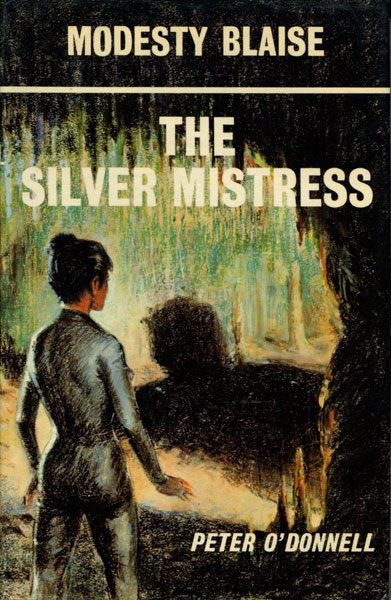
    Later on, after eating alone, Lin settled on the sofa with a glass of coke, David Bowie’s Aladdin Sane on the stereo and one of her dad’s Modesty Blaise paperbacks. This one had a collection of short stories featuring the female James Bond character and her cockney sidekick, Willie Garvin, Lin’s all-time favourite fictional character. As the best track, Drive-In Saturday, came on, the doorbell rang. Figuring it was probably Corinne checking to make sure she’d spotted the salad in the fridge, she answered it, standing back as Don asked if he might come in.
    She hesitated and he peered past her. “You must be ready to eat. I promise I won’t take much of your time.”
    “Actually, I’ve not long finished.” She closed the book around her bookmark. Despite Peter O’Donnell’s considerable writing talents, she’d struggled to engage with the first short story as her over-tired brain couldn’t cope with the wealth of detail. Even after such a full-on day, she wasn’t relishing the idea of another long, lonely evening of nothing but her own company. Opening the door fully, she gestured for him to enter.

    He stood in the hallway, gazing at the double staircases flanking the balcony linking them. “Blimey. It’s like one of those stately homes me ma used to drag us around when we were kids.”
    Was this his purpose? To snoop at the sort of posh house he could only dream of living in? Actually, that wasn’t fair – if the next two albums sold as well as the second, he’d be close to affording somewhere grand. And although she might expect such behaviour from others in the band, he seemed much more grounded.
    Folding her arms, she watched him flounder at the evidence of such wealth. Because she’d never acted like the stuck-up snobs at the convent, he had no reason to think she had such a luxurious lifestyle. Studying his plain white tee-shirt, black leather jacket and flared blue-jeans, she thought he looked much more comfortable than in the sparkly gear the manager insisted they wore so he could take publicity shots of them during today’s recording. She figured he didn’t enjoy the outrageous sequined outfits and knee-high platform boots.
    He blinked, and she glanced away, realising she’d been staring at him while he studied the house.
    “I’m … er … I just wanted to say thanks for helping me out earlier. I’ve never had to think about being too loud as we always did belters. I’m chuffed because it’ll give us more scope for ballads.”
    “You’re welcome.” She led him through to the lounge where he removed his jacket, draping it over the sofa.
    They sat, his gaze taking in the framed gold disk hanging above the fireplace. “It must be pretty awesome hanging around with Granite. They were my favourite band when I was at school. I probably wouldn’t have taken up music if it wasn’t for them.”
    Making a non-committal sound, she tried to decide if he was merely angling for an autograph – or maybe a free ticket to one of their gigs.
    He shifted his weight, his eyes darting around.
    Surely he didn’t want a backstage pass? Silly question. Of course he did, but she badly wanted to believe it wasn’t his prime motivation.
    “Um … Zac’s good at the softer stuff.” He was fishing.
    “You think? His voice is too gravelly.”
    “But all the girls go wild for it.”
    She tutted. “You’d think he smoked at least twenty Woodbines a day.” The very idea of the pungent cigarettes made her shudder.
    “He doesn’t; he’s quite precious about his instrument.”
    Twitching her lips, she wondered how come her mind was so much smuttier than his.
    He frowned for an instant before catching on and blushing all the way to the roots of his hair. “You know what I meant. You like him, don’t you?”
    She shrugged. “He’s okay, I suppose. A bit too full of himself for my taste.”
    “He really likes you.”
    Scoffing, she folded her arms. “He’d chat up anything in a skirt. Bless him, he needs a constant reminder of how sexy he is. His massive ego needs a lot of stroking.”
    “Really?” Don’s eyes widened for a split second before clouding over. “I bet you think the same about all the guys who come here to record. They must fall over themselves to chat you up.”
    “Strangely, no.” Her tone mocked herself. “Unless they think I can get them a backstage pass to a Granite gig.”
    “You can do that?” His inner fan leapt to the fore, undermining his attempts to play it cool. “’Course you can. Your boyfriend must be chuffed – assuming he’s a fan.”
    “He’s not.”
    His face dropped at the implied confirmation of her relationship status. “He probably prefers the classical stuff your ma’s into.”
    “Nope.” Keeping her face straight took everything.
    “Don’t tell me he’s into jazz or some other old-folks’ shit. Sorry, I mean stuff.”
    Figuring she’d probably made him squirm enough, she spoke quietly. “I don’t have a boyfriend.”
    “Or middle-of-the-road … you don’t? How come?” A beat. “Sorry. That was rude. But I’m glad. I mean, not for you …” He broke off, squirming.
    “Why did you come here, Don? To make me uncomfortable about being single? Or was it to get a ticket for the next Granite gig? Or better still a backstage pass?”
    His face scrunched up and he stood. “Sorry. I’ve proper cocked this up. I should go.”
    She rose, blocking his exit. “Not until you tell me why you came.”
    His eyes darted around the room and he took a step back, trying to put some distance between them. “I … um … wondered if you could help me again. After being so kind earlier …” He broke off at her relentless glare, but found the courage to continue. “You see, I don’t know anyone else I would trust not to laugh.”
    For some reason, her filthy mind returned to Jack’s little pinky and she bit back the urge to grin. Then she realised the seriousness of her situation, alone in the house with a much older guy.
    Common sense prevailed – Don was a nice guy and if he had evil on his mind like the boy in Helen Reddy’s Angie Baby, he wouldn’t be afraid of people laughing. She narrowed her eyes. “Laugh at what?”